

Solar Battery Storage Explained: Costs, Sizes and the Best Battery for You
A home battery stores the solar your panels make in the day so you can use it in the evening. Here's how storage works, what it costs, what size you need and what to look for when you compare batteries.
On this page
- A battery lets you use your own solar in the evening instead of exporting it cheaply and buying electricity back later.
- Every Spark system fitted in 2026 included a battery. 10 kWh was the most popular size, chosen by 48% of homes.
- Like for like, a 10 kWh battery instead of 5 kWh added roughly £800 to £1,600 to the price of a Spark system.
- When you compare batteries, look at usable capacity, power output, warranty, chemistry and whether it can grow.
What Is a Solar Battery?
A solar battery stores the electricity your panels generate during the day so you can use it when you need it, most usefully in the evening, when the sun has gone down but your home is using the most power.
Without one, surplus daytime solar is exported to the grid for a payment that is usually lower than the price you pay for electricity after dark. A battery can also be fitted without solar or added to existing panels.
How a Home Battery Works
During the day, your panels power your home first. Any surplus charges the battery rather than going straight to the grid. In the evening, your home draws on that stored energy instead of buying from the grid.
Most batteries can also charge from the grid in cheap off-peak hours, so in winter, when solar is weak, you can still store low-cost electricity for the expensive evening peak. Our guide to tariffs for battery owners explains how to choose one.
Is a Solar Battery Worth It?
For most homes with solar, yes. A battery means you use more of your own solar, which cuts what you buy from the grid and shortens payback.
It's most worthwhile if you use a fair amount of electricity in the evenings, have an electric car, or are on, or moving to, a time-of-use tariff. Our payback guide works through the numbers for a typical Spark system with a 10 kWh battery.
How Much Does a Battery Cost?
In 2026, Spark customers paid a median of £14,226 for solar panels and a battery together, fully fitted at 0% VAT.
For homes with the same number of panels, choosing a 10 kWh battery instead of 5 kWh added roughly £800 to £1,600. Our cost guide sets out what homes paid by system and battery size. Batteries are zero-rated for VAT until 31 March 2027 (HMRC VAT Notice 708/6).
What Size Battery Do I Need?
As a rule of thumb, size the battery to cover your evening and overnight use, not your whole day. A battery that fills and empties most days earns its keep.
| Battery size | Share of Spark homes in 2026 | Often suits |
|---|---|---|
| 5 kWh | 34% | Lower electricity use, or a smaller system |
| 10 kWh | 48% | Most family homes |
| 15 kWh or more | 18% | High use, an electric car, a heat pump, or a time-of-use tariff |
From 525 Spark solar and battery orders signed between 1 January and 5 November 2026.
For scale, Ofgem's typical medium home uses 2,500 kWh of electricity a year, about 7 kWh a day. Our sizing guide shows what homes with different levels of use chose. Our guide to what size battery you need goes further, with what homes at each level of use chose and a rule of thumb for your own bill. If you're planning an electric car or heat pump, tell us: future use matters more than last year's bill.
How to Choose the Best Solar Battery
Battery brochures use a lot of terms. These are the ones that matter when you compare.
- Usable capacity (kWh). How much energy you can actually use, which can be less than the headline figure.
- Power output (kW). How much the battery can supply at once. Too low, and it can't run the kettle and oven together without help from the grid.
- Warranty. The number of years, and the share of capacity guaranteed at the end. Batteries typically come with 10 to 15 years.
- Chemistry. Lithium iron phosphate (LFP) is the most common chemistry in home batteries and is valued for its long cycle life and thermal stability.
- Expandability. Modular batteries let you add capacity later, for example when you get an electric car.
- Backup. Not every battery powers your home in a power cut, and those that can usually cover selected circuits only.
- Tariff compatibility. Some smart tariffs only work with certain batteries.
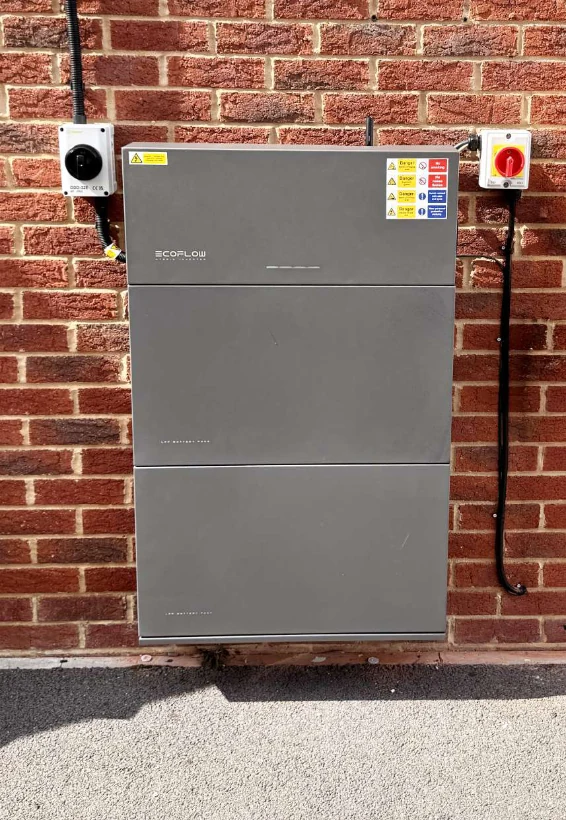
We fit the EcoFlow OCEAN 2: LFP modules of 5 kWh or 8 kWh with a 15-year manufacturer warranty, so storage can be sized to your evenings and expanded later. Backup power is included only where it's agreed in your order. See our EcoFlow OCEAN 2 page and battery storage page.
How Long Does a Battery Last?
The Energy Saving Trust puts home battery life at around 10 to 12 years, shorter than the panels.
Capacity fades gradually rather than stopping suddenly. Our lifespan guide covers how long each part of a solar system lasts and what the warranties mean.
Your Questions, Answered.
What is a solar battery?
It stores the electricity your panels generate during the day so you can use it later, most usefully in the evening, instead of exporting it cheaply and buying electricity back at a higher price.
Is a solar battery worth it?
For most homes with solar, yes. It increases how much of your own solar you use, which lowers bills and shortens the payback of the whole system, especially with evening use or a time-of-use tariff.
How much does a solar battery cost?
Spark customers paid a median of £14,226 for solar and a battery together in 2026. Like for like, a 10 kWh battery instead of 5 kWh added roughly £800 to £1,600.
What size solar battery do I need?
Size it to your evening and overnight use. 10 kWh was the most popular size with Spark customers in 2026, chosen by 48% of homes; lower users often chose 5 kWh.
What is the best solar battery in the UK?
The best battery for you has enough usable capacity and power for your evenings, a long warranty, LFP chemistry and room to expand. Spark fits the EcoFlow OCEAN 2, which has a 15-year manufacturer warranty.
Can I add a battery to existing panels?
Yes. A battery can be added to most existing solar systems, including panels fitted by another company.
Store Your Sunshine
Get a free quote for solar and a battery, sized around how your home really uses energy.
Get My Free Quote