

The Best Solar Panels in the UK (2026): How to Compare Them
There's no single best panel for every roof. Here's what matters when you compare them, the datasheet figures for five widely sold makes side by side, and why we fit the panels we do.
On this page
- The best panel for you is the one that gets the most generation from your roof for the price, backed by a warranty from a maker that will be around to honour it.
- Compare efficiency (output from limited roof space), warranties (product and performance), degradation and temperature coefficient.
- Leading panels in 2026 reach about 22% to 25% efficiency and guarantee 87% to 92% of their output after 25 to 30 years.
- Spark fits Aiko Neostar all-black panels. We say so up front, and the table uses each maker's own datasheet.
What Makes a Good Solar Panel?
Five things on a panel's datasheet tell you most of what you need to know.
- Efficiency. How much of the sunlight hitting the panel becomes electricity. Higher efficiency means more power from the same roof area, which matters most on smaller roofs.
- Product warranty. Covers defects in the panel itself. Typically 12 to 25 years.
- Performance warranty. Guarantees how much output the panel keeps over time, usually stated as a percentage after 25 or 30 years.
- Temperature coefficient. How much output drops for each degree the panel heats above 25°C. Closer to zero is better.
- Cell technology. Most new panels use N-type cells (TOPCon, heterojunction or back-contact), which lose less output each year than older P-type panels.
Two things matter as much as the panel: the installer's design for your roof, and the inverter and battery the panels feed. A great panel badly placed in shade will underperform an average one in sun.
Five Panels Compared
These are typical residential models from five makers widely sold in the UK, using each maker's published figures.
| Panel | Power | Max efficiency | Product warranty | Performance warranty |
|---|---|---|---|---|
| Aiko Neostar 3S+54 (back-contact, dual glass) | 480 to 490 W | 24.5% | 30 years | 88.85% after 30 years |
| LONGi Hi-MO X10 (back-contact) | 480 to 505 W | 24.74% | 15 years | 88.85% after 30 years |
| REC Alpha Pure-RX (heterojunction) | 450 to 470 W | 22.6% | 20 years (25 via REC installers) | 92% after 25 years |
| Jinko Tiger Neo 54HL4-B (TOPCon) | 400 to 420 W | 21.51% | 25 years | 87.4% after 30 years |
| JA Solar DeepBlue 4.0 Pro (TOPCon) | 445 W | about 22.3% | 25 years | 87% after 30 years |
Figures from manufacturers' datasheets: Aiko, LONGi, REC and Jinko (a 2022 datasheet; newer Tiger Neo models are more efficient). JA Solar figures are from a distributor listing. Checked 14 November 2026. Makers update ranges often, so check the datasheet for the exact model on your quote.
The differences between these panels are smaller than the marketing suggests. On a typical roof, the gap in yearly generation between a 22% and a 24.5% panel of the same total size is small. Efficiency matters most when roof space limits how many panels you can fit.
Temperature coefficients are close too: −0.24%/°C for REC, −0.26%/°C for Aiko and LONGi, −0.29%/°C for Jinko and −0.30%/°C for JA Solar, from the same datasheets. On hot summer days the lower figures hold on to slightly more output.
Why Spark Fits Aiko Panels
We fit Aiko Neostar all-black panels as standard. We chose them for three reasons.
- Output per panel. At 24.5% efficiency and up to 490 W, they get a lot from a typical UK roof, which helps on smaller and east-west roofs.
- Slow ageing. Aiko guarantees no more than 0.35% loss a year after the first year, and 88.85% of output after 30 years.
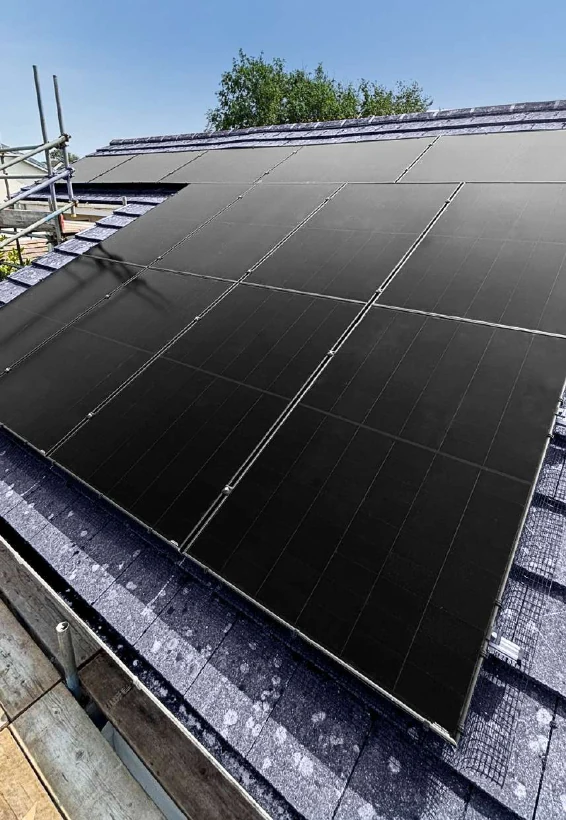
- Looks. Back-contact cells have no silver lines on the front, so the all-black panel looks discreet on most roofs.
They aren't the only good panel. The other panels in the table are well regarded too. If you're comparing quotes, use the questions below rather than the brand name alone. More on our Aiko panels page.
Questions to Ask Any Installer
These questions help you compare quotes that use different panels.
- What is the exact panel model, and can I see its datasheet?
- Who honours the product and performance warranties, and is there a UK contact?
- What will the system generate in a year, and has the forecast been checked independently?
- What is the price per kWp (the total price divided by the system size)?
- How does the design deal with any shading on my roof?
- Is the panel on the MCS product list? (You need an MCS-certified installation for export payments.)
Our quote comparison guide covers the rest of what to check, and our lifespan guide explains what the warranties mean over time.
Your Questions, Answered.
What are the best solar panels in the UK?
There's no single best panel for every roof. Leading residential panels in 2026 reach about 22% to 25% efficiency and guarantee 87% to 92% of their output after 25 to 30 years. Compare efficiency, warranties and price per kWp for your roof.
What is the most efficient solar panel for a home?
Back-contact panels such as Aiko Neostar and LONGi Hi-MO X10 are among the most efficient residential panels, at about 24.5% to 24.7% on their datasheets.
Are Aiko solar panels good?
Aiko Neostar panels use N-type back-contact cells, reach 24.5% efficiency. The Neostar 3S+ carries a 30-year product warranty and a 30-year performance warranty guaranteeing 88.85% of output. Spark fits Aiko panels as standard.
Does panel efficiency matter?
Mostly when roof space is limited. Higher efficiency means more power from each panel. On a large roof, a slightly less efficient panel can give similar total output.
What warranty should solar panels have?
Look for a product warranty of at least 12 to 25 years and a performance warranty guaranteeing around 85% or more of output after 25 to 30 years, from a maker with a UK presence.
Get a Quote With Premium Panels
A free, no-obligation quote designed around your roof, with EPVS-validated savings.
Get My Free Quote